
At a Glance
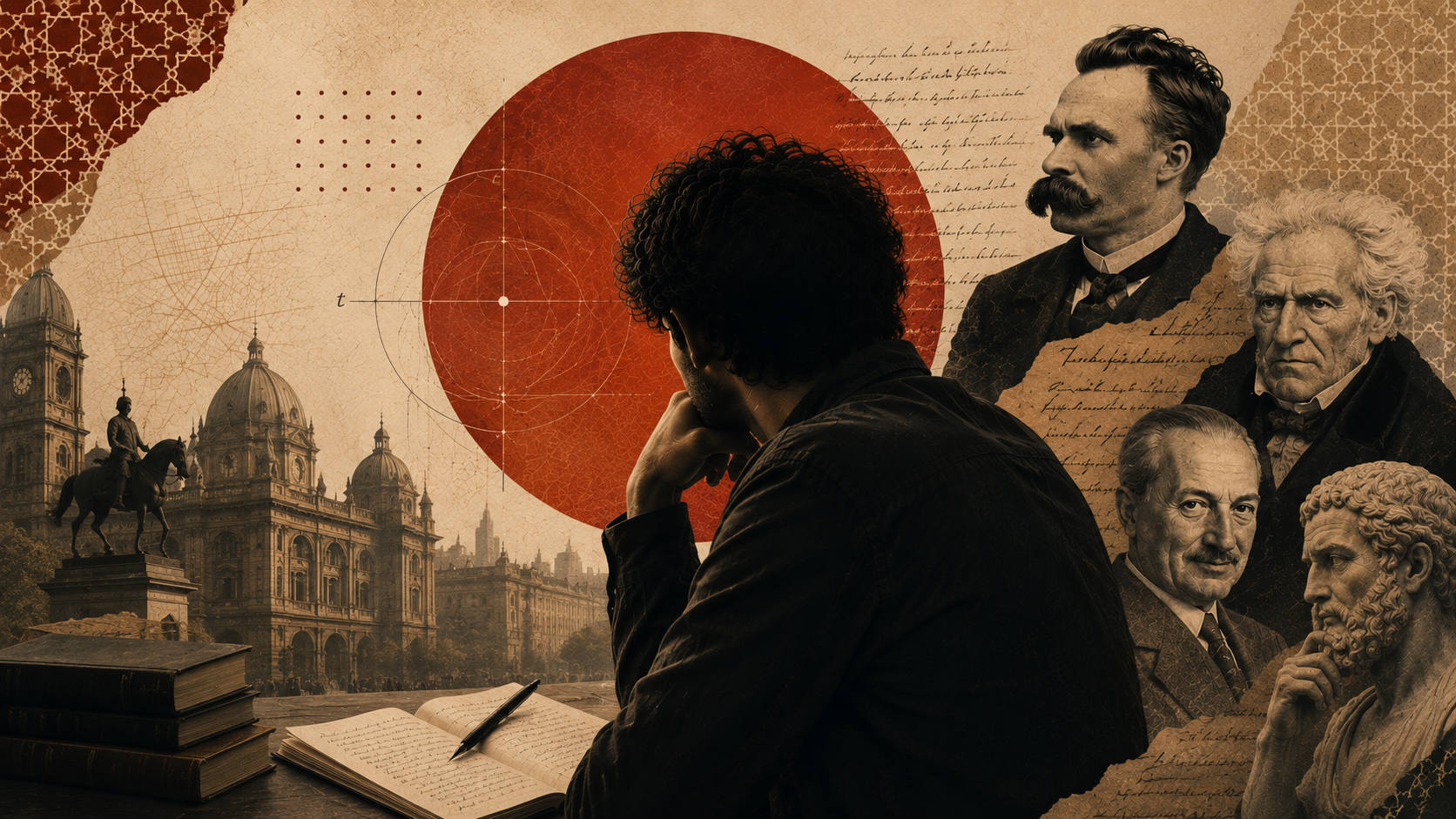
What if philosophy did not begin with a philosopher, but with a problem?
In this essay, Alessandro Umberto D’Aloia introduces microphilosophy, a method of using philosophical concepts as tools rather than treating philosophers as authorities. The approach starts with the problem itself and draws from different thinkers only when their ideas are useful to that particular problem. Using his own work on film, time and experience as a starting point, D’Aloia argues for a form of philosophical thinking that can move beyond established systems and recognise philosophy as something that happens in everyday life, research and problem-solving.
Key Words: Microphilosophy · Philosophical Methodology · Film Philosophy · Gilles Deleuze · Temporality · Affect
This is an autogenerated brief. Please read the entire article for context.
“We were somewhere near Bourke Street halfway through our second jug of beer when suddenly I came up with the idea for microphilosophy. My friend and fellow colleague at the time, now Dr. Leroy Clunne-Kiely, had just gone and bought himself a big bag of salt-and-vinegar chips. He was sitting down, settling into them with a deep-dish satisfaction following the success of his confirmation of candidature on light displays and low-friction dynamic systems, sandwiched in between a pseudo-social-scientific séance for dead cats and a Herald Sun enthusiast who was trying to convince their examiners that the Murdoch press was the only source of unbiased political commentary on Australian voter preferences.”
This much I remember writing in the first rendition of my doctoral thesis, Autonomy and Time. Much to the chagrin of my own examiners, whose identities remain, to this day, anonymous for other political reasons beyond my control.
The whole pub spiel might have been, and might still be, a bit too inauspicious, maybe on the nose, unbelievable even, for me to write about academically. But back then I was adamant that, in order to better evidence the affect of time—that is, the role past experience plays in shaping our interpretation of a text in the present, given moment—I needed to document the origin of my ideas. Just like Hunter S. Thompson felt the need to inhabit the lifestyles of those individuals, like the Hells Angels, who would later come to define his iconic gonzo journalism. Indeed, and in keeping with the spirit of this practice, I also want the reader to know that I have written the bulk of this essay on my phone, on the train, while commuting to and from work this past fortnight; that I come up with some of my best ideas while actually moving; and that, how convenient for you, today’s train is delayed some 30 minutes!
Now, I distinctly recall that Leroy, for that is his name, and that is how I greet him to this day, even if referring to a colleague on a first-name basis remains another practice discouraged within academia. I distinctly recall that Leroy was lamenting the absence of what he referred to at the time as some kind of universalising “ground truth” to experience, which I more than empathised with. Just like the scientist he was, he is, he wanted to be able to say with utmost objective conviction: this is what another person sees. We don’t really know that, I said, because we have no direct access to the qualia of their experience. The interminable gap between you and I can only ever recede intersubjectively upon some mutually assured basis.
In more complicated terms, we both lacked a stable ontological work with which to frame the development of new knowledge. The epistemological grasp of our research (our finding out about new things that were so new they had never been written about by anybody else before) seemed to be exceeding our hypothetical reach in terms of the theoretical frameworks available to interpret and convey our findings. No such framework existed—and today, even after the second rendition of my thesis, itself curtailed in some respects and expanded in others, I have yet to fully offer any one alternative. Perhaps that is the point. The nearby frameworks in our respective disciplines were not specific enough to deal with our problems in any totalising way, either.
Add to this the pedagogical, almost pathological, need for academics to cite primary literature on any given subject matter. Just yesterday, in fact, I was talking with Sruthi Madhu about how Indian academia still demands the citation of a relevant text when Indian theatre is largely unpublished, heaving more of an oral tradition. You can begin to see why something like microphilosophy was both needed and discouraged by the wider academic community. Microphilosophy represents a critical break from convention, if only because the nature of certain research problems—like the affect of time—can exceed that conventional basis.
I joked to Leroy that what we needed was some kind of Jim’s Philosophy instead. “Mows your lawns and your forlorns,” I quipped. The onomastic formula of Jim’s [something] borrows from the popular franchise, a la Jim’s Mowing, Jim’s Cleaning, Jim’s Plumbing, etc.. What I wanted to emphasise was that philosophy isn’t restricted to the desk or text, or even the philosopher. Philosophy, philosophical problem-solving, is being conducted by everyone, everywhere, every single day, whether or not it is being acknowledged as such.
Such philosophical movements are not unlike the microeconomic movements we all participate in throughout our day-to-day lives, which also have an affect, through degrees, in shaping the larger macroeconomic movements that we later come to understand as broader market trends. In this sense, the prefix micro- does not necessarily mean small. It describes the scale at which the problem is first encountered, often without needing to universalise that problem into a broader philosophical system. For me, that problem was: how does time affect the audience of the moving image?
But what is microphilosophy, then, really?
Contrary to Julian Baggini’s diminutive podcast of the same name, microphilosophy is the methodological practice of making a toolkit out of philosophers. Maybe Nietzsche just isn’t cutting it today. Maybe you need a little bit of Schopenhauer’s insistence that life without pain has no meaning. Or maybe, maybe you don’t feel comfortable using Heidegger because of his affiliations with Nazism—which is fair, even if some of his ideas are good. So you temper his notions with a bit of Husserl, or dispense with them altogether.
This does not mean simply cherry picking the bits of philosophy we like and discarding those we don’t. Microphilosophy is not eclecticism for eclecticism’s sake. The problem determines the tool; the philosopher does not determine the problem. It is about recognising that a theoretical framework can be useful without requiring us to inherit the entire philosophical system from which it came. Sometimes a concept gets us part of the way there. Sometimes we need another one to get us just that little bit further. Sometimes the tool we thought we needed turns out to be completely wrong for the job.
Microphilosophy, methodologically speaking, is all about swapping out the wrong tool for the right problem, and in much the same way we don’t use a hammer to nail in a screw. This is not for me to suggest you can’t hammer in a screw. You can. It’s just not as effective.
So much to instead say: microphilosophy makes tools out of concepts rather than authorities out of philosophers. And on a much more personal basis, as relates to film philosophy, and my being a film philosopher of sorts, Gilles Deleuze.
For those who have never heard of them before, Deleuze has become to film philosophy what Einstein is renowned for by name alone. To the extent that it has become remarkably difficult to talk about film philosophy without Deleuze, and, in many ways, without first passing through his vestigial gaze. This is not because his ideas were bad, far from it. Their affect on film theory has been so profound that their influence has begun to exceed their own conceptual grasp: almost no new theory can emerge without first negotiating the theoretical territory they continue to occupy. And so, the problem is not Deleuze’s philosophy so much as what happens when an extraordinarily useful set of concepts—such a fine tool in its own right—becomes like a multitool. When its very usefulness encourages us to reach for it out of ease, regardless of the problem at hand.
Thus, I offer no tenets or dot points or pillars that adherents or proponents of microphilosophy should follow like other manifestos, should there be any takers. I think that would miss the point entirely. A methodology, unlike a theory or a practice, is a way of being. Of a mindfulness like slowness or a stoicism. We can’t always be stoic or mindful or this or that, though. Life demands of us many things, not all of them problems. And not all problems demand of us the same thing.
Author’s Note: The author would like to thank Leroy Clunne-Kiely and Sruthi Madhu for their respective contributions to this discussion.
Dr. Alessandro D’Aloia
Alessandro Umberto D’Aloia is a film philosopher, researcher and writer from Melbourne, Australia. In 2025, he completed his doctorate of philosophy at RMIT University, where his thesis, Autonomy and Time, examined how time affects the audience of the moving image. His research traverses cinema, television, affect, temporality and phenomenology, drawing these traditions together through a methodological practice he calls microphilosophy.
Alessandro also holds First Class Honours in Media and Communication, as well as a Bachelor of Arts (Creative Writing) with Distinction from RMIT majoring in screenwriting. His work has appeared in M/C Journal and Screen Thought, with recent research extending his work on time, affect and interpretation into questions surrounding generative AI and large language models. He is currently a Resident at the Australian Centre for the Moving Image (ACMI), where he is currently investigating what it means to make a ‘goat gland’ film in the 21st Century.