
At a Glance
What happens when the systems through which we understand the world begin to shape the world we are capable of imagining?
This essay examines the emergence of the Algorithmic Global Imaginary, a techno-symbolic order in which algorithms, platforms and datafication increasingly influence how knowledge is produced, how people are represented, how social behaviour is governed and how the future itself is imagined. Drawing on Arjun Appadurai’s theory of global imaginaries, Sheila Jasanoff’s concept of sociotechnical imaginaries and Tommaso Durante’s work on the global imaginary and global iconology, the essay reads an AI-generated image of a humanoid robot contemplating the Earth as an allegory of this transformation. The image brings together the central tensions of the algorithmic condition: human and machine, local and planetary, agency and determination, connection and extraction. What emerges is not a single technological future, but a contested field of competing imaginaries in which corporations, states, communities and civil society are all struggling to determine what the digital world should become.
Key Words: Algorithmic Global Imaginary · Social Imaginaries · Datafication · Platform Capitalism · Sociotechnical Imaginaries · Global Iconology
This is an autogenerated brief. Please read the entire article for context.
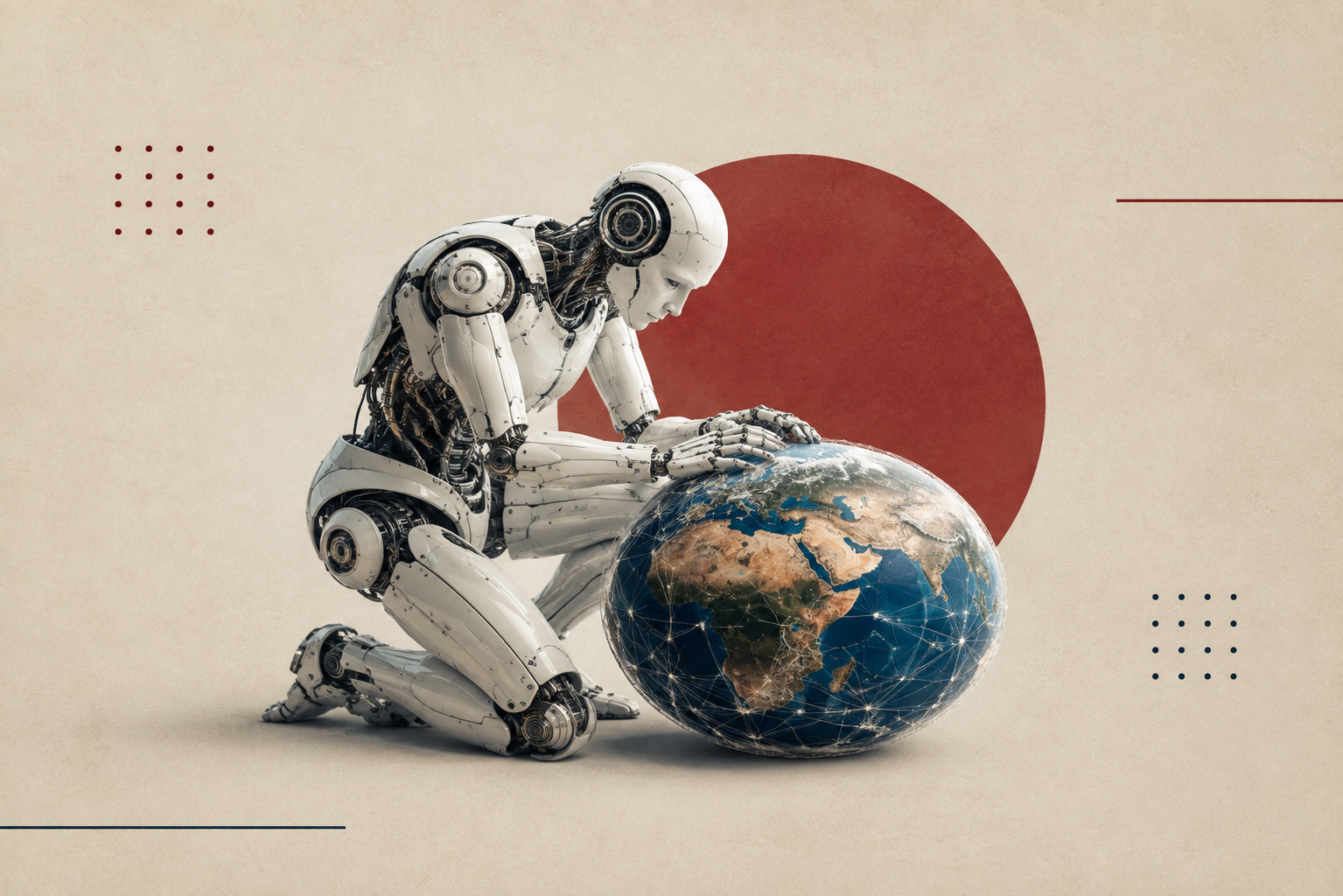
A white humanoid robot kneels before the Earth.
The planet is covered by a luminous network of lines and nodes, as though the globe has been converted into an enormous computational system. The robot is recognisably human, yet everything about its imagined existence belongs to the technological world: algorithms, sensors, artificial intelligence, computation and data. It appears to be contemplating the planet, although the same posture could also suggest surveillance, measurement or control.
The image was generated by artificial intelligence. That fact makes it more than an illustration of the argument that follows. It is itself a small product of the technological order the argument is trying to understand. The Earth in the image also carries a history of its own. Since the Apollo 8 mission’s Earthrise photograph in 1968, the image of our planet seen from space has become one of the most powerful symbols of global consciousness. Earth appeared whole, fragile and strangely small, stripped of the borders through which political life is normally organised. The photograph became associated with environmental consciousness, planetary vulnerability and the idea of a shared human fate.
In this image, however, Earth is being observed by something other than a human being. The human subject who once looked at the planet from outside has been replaced by a machine constructed through the technical systems that increasingly organise life on the planet itself. The robot looks at the world while also belonging to the world it is looking at. The image therefore gives us a useful way into a larger question: what happens when the global imagination itself becomes increasingly algorithmic?
From the Global Imagination to the Algorithmic One
Arjun Appadurai’s account of globalisation provides one of the starting points for this question. In Modernity at Large, Appadurai challenged accounts of globalisation that treated it simply as the movement of capital, commodities and people. His concept of disjunctive global scapes drew attention to the circulation of images, technologies, people, finances and ideas across boundaries that no longer correspond neatly with the territorial organisation of the nation-state.
What mattered in this transformation was not only that people could encounter distant places. The imagination itself became a social practice. Electronic media and mass migration allowed ordinary people to imagine lives, identities, communities and futures that exceeded the geographical and cultural boundaries of their immediate surroundings. Imagination was no longer primarily the preserve of artists, priests, intellectuals or state actors. It became part of everyday social life.
Digital platforms have extended this condition enormously. A person can enter a community organised around an interest that has no local equivalent, follow political events taking place on another continent, encounter cultural practices from places they have never visited, or construct an identity from materials drawn from multiple parts of the world. The resources available for imagining possible lives and alternative futures have become almost impossibly extensive. However, the digital environment does not simply make more of the world available. It also decides, with increasing precision, which parts of that world become visible to particular people. Recommendation systems, search rankings, personalised feeds, trending mechanisms and automated classifications organise the flow of information through which the global imagination now operates.
The imagination has expanded, but the conditions under which it expands have become increasingly computational. This produces a paradox at the centre of the Algorithmic Global Imaginary. Digital platforms have made possible an unprecedented scale of imaginative self-construction and collective world-making, while their architectures simultaneously channel that imagination through systems designed around engagement, data extraction and prediction. Filter bubbles, echo chambers and the amplification of emotional and political extremes are not accidental disturbances within an otherwise neutral system. They are connected to the architecture through which the system organises attention. The global imagination is consequently both expanded and managed.
When the Medium Becomes an Environment
This is where the question of communicative power becomes important. The power to determine how the global is imagined does not depend solely upon producing the images, stories or political messages that circulate through society. It also lies in determining the conditions under which those messages circulate. A platform does not simply carry communication from one person to another in the manner of a traditional channel. It establishes an environment in which some forms of communication become more visible, more connected, more profitable or more likely to be encountered than others.
The platform can be said to be part of the symbolic order it appears merely to transmit. In my research, I have developed a framework of the global imaginary that places this communicative dimension at the centre of the analysis. The global imaginary is produced through media representations, narratives and symbolic resources, but these are always embedded in infrastructures whose distribution of power is unequal. In the algorithmic condition, this symbolic power takes a different form. It is exercised through the design of the architectures through which information moves.
A news feed does not need to instruct someone what to believe. It can influence what they repeatedly encounter. A recommendation system does not need to announce a political position. It can determine which voices become familiar, which subjects become salient and which communities become visible. A platform does not have to manufacture every desire it circulates. It can cultivate an environment in which certain desires are repeatedly reinforced. This is why the algorithmic global imaginary is a communicative formation as much as a technological one. The global mind produced through billions of interactions with platforms is not simply the sum of those individual interactions. It becomes an emergent symbolic environment whose contours are shaped by platform architectures, commercial imperatives and the cultural assumptions embedded within the systems that organise digital life.
Four Ways of Seeing the Algorithmic World
The Algorithmic Global Imaginary operates across several dimensions at once. The research framework identifies four interlocking registers through which it can be understood: epistemic, ontological, normative and cosmological. The epistemic register concerns what can be known. Algorithms process enormous quantities of information and turn behaviour into patterns, classifications and predictions. They influence what becomes visible, what can be measured, what counts as relevant information and what can be inferred about individuals and populations.
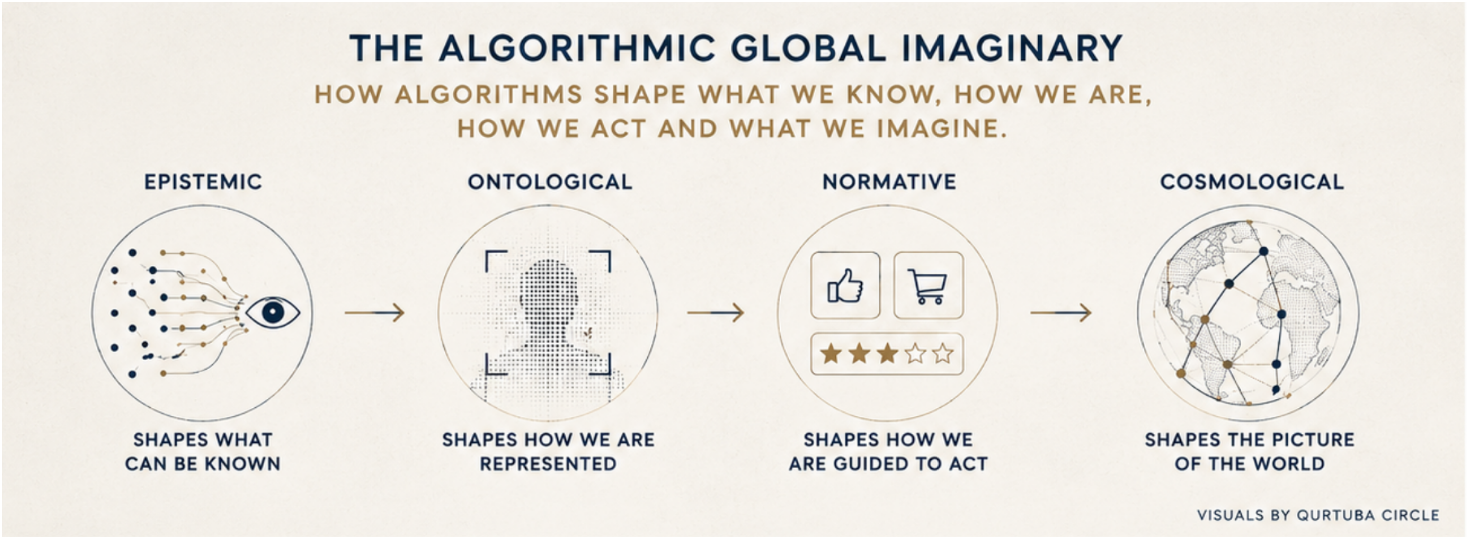
The ontological register concerns what kinds of subjects and objects emerge through these systems. A person can become a user profile, a behavioural pattern, a node within a network or a set of predicted preferences. Social relations can be represented as data structures, while cities and populations become collections of measurable movements and interactions. The normative register concerns what kinds of behaviour are encouraged or discouraged. Recommendation systems, rankings, scoring mechanisms and optimisation processes do not simply describe behaviour. They create incentives around it. Embedded within these systems are assumptions about attention, productivity, relevance, popularity, risk and desirable conduct.
The cosmological register reaches further. It concerns the picture of the world that emerges when reality itself becomes increasingly available to computational representation. The networked globe in the humanoid-robot image is significant precisely because it does more than depict connection. It presents the planet as a system of nodes, flows and relationships that can be mapped, processed and governed. These registers overlap. The system that knows us in one form can also reorganise how we understand ourselves, influence how we behave and contribute to a wider picture of what the world itself is.
Three Ways of Understanding the Imaginary
Appadurai, Jasanoff and my framework approach the problem from different directions, and that difference is important because none of the three frameworks is sufficient on its own. Appadurai allows us to see how digital technologies expand the resources through which people imagine possible lives and communities. His account helps explain why the algorithmic condition should not be reduced to technological domination. There is a genuine expansion of imaginative possibility in the digital environment, and that expansion matters. Jasanoff shifts the question towards the relationship between technological systems and political order. Her concept of sociotechnical imaginaries emphasises that visions of technological futures are produced alongside visions of desirable societies. Technology therefore cannot be separated from the political assumptions that accompany it.
The Silicon Valley imaginary provides one clear example. Its emphasis on innovation, disruption, growth and technological problem-solving has achieved extraordinary global circulation through the dominance of American technology corporations. Yet it is not a universal vision of technological modernity. It competes with the European emphasis on digital rights and regulatory sovereignty, the Chinese model of state-directed artificial intelligence and digital sovereignty, and the demands for digital justice and data sovereignty articulated by civil society organisations and communities in the Global South.
To this, I add a specifically communicative and symbolic dimension to these questions. The global imaginary is formed through the circulation of representations, but that circulation is never politically innocent. The architecture through which symbols move becomes part of the production of the imaginary itself. Together, these perspectives reveal why it would be misleading to speak of one unified technological future. The Algorithmic Global Imaginary is better understood as a contested field of sociotechnical imaginaries, in which different institutions and communities attempt to establish different answers to the question of what digital life should become.
The Robot and the View from Nowhere
The humanoid robot brings these theoretical questions into a single figure. Its planetary gaze can first be read as an expression of the epistemic ambition of algorithmic systems. The machine appears capable of looking at the planet as a whole, processing information on a scale that exceeds individual human perception. It approaches what Thomas Nagel’s philosophical discussion of the “view from nowhere” makes conceptually troubling: the aspiration towards a perspective that appears comprehensive and detached from any particular position.
Algorithms can produce something that resembles such a perspective. They process the traces of billions of lives and return classifications, recommendations and predictions that can acquire the appearance of objective knowledge. But there is no genuinely neutral computational view. Algorithms are designed by particular people and institutions. They depend upon selected categories, training data, economic priorities and political assumptions. Their outputs may appear objective while reflecting the circumstances in which the systems themselves were produced. The robot’s gaze therefore carries a contradiction. It appears disinterested precisely because its interests have disappeared from the image.
The same contradiction operates in the robot’s humanoid form. The machine is designed in the image of the human so that it can perform human functions such as communication, care, labour and social interaction. At the same time, the human subject is increasingly represented through the categories of computation: as a data subject, behavioural profile or network node. N. Katherine Hayles’s account of the posthuman helps illuminate this transformation. The posthuman does not simply mean the disappearance of the human. It describes a reconfiguration in which technical systems become constitutive of how the human itself is understood. The robot is both familiar and alien. It is recognisable because it reproduces the human form, yet estranging because it turns that form into something that can operate according to another logic. Yes, humanity has built the machine in its own image, while increasingly allowing the machine to represent humanity in its own.
The Other Side of the Gaze
There is, however, another dimension to the image that becomes visible once the question of power enters the analysis. The Earth before the robot is also the source of the human activity from which algorithmic systems derive their power. The billions of people represented within the network are not simply inhabitants of the planet. Their searches, movements, preferences, communications, relationships and other activities generate the data from which digital systems learn and through which they operate. The planetary gaze can be read as an extractive gaze.
This is where the work of Nick Couldry and Ulises Mejias on data colonialism becomes important. Their argument draws attention to the appropriation of human social life as raw material for capital and power. Datafication does not merely produce better information about an already existing social world. It incorporates increasing portions of social life into systems of extraction. Platform capitalism intensifies this process. The technological system appears to offer connection, convenience and personalisation while its underlying architecture can be organised around the extraction of value from participation itself. James H. Mittelman’s observation that algorithms can operate as proxies for the power of capitalism extends this argument. To understand an algorithm, it is insufficient to ask what the system technically does. One must also ask what economic imperatives are embedded in its architecture and what social hierarchies that architecture helps reproduce.
This is why the visual details of the robot image matter. Its hands rest around the network covering the Earth, suggesting intervention in the planet’s informational architecture. Its white, clinical background removes history, labour, inequality and environmental cost from view. The result is an image of technological reason that appears clean, transparent and universal. The absence of friction is itself meaningful. The actual expansion of digital capitalism depends upon infrastructures, labour, energy, minerals, data and institutions. None of these appear in the image. What remains is the reassuring figure of the machine contemplating a connected world. The image consequently does ideological work even before anyone explains it.
The Global Imaginary as a Site of Struggle
The dominant Algorithmic Global Imaginary is not evenly distributed, nor is it universally accepted. The concentration of technological power within a relatively small group of highly capitalised corporations gives particular cultural and economic assumptions an extraordinary global reach. Individualism, growth, optimisation and the reduction of social complexity to measurable preference can become embedded within systems that are then presented as universal technologies.
Yet other imaginaries are being constructed alongside it. The European Union’s General Data Protection Regulation, Digital Services Act and AI Act express an alternative sociotechnical vision in which individual rights, democratic accountability and regulatory authority place limits upon technological power. China’s development of state-directed artificial intelligence and digital sovereignty represents another model, one in which collective objectives defined by the party-state take precedence over individual privacy and market freedom.
Civil society movements introduce further possibilities. Algorithmic accountability, data trusts, platform cooperativism and the demand for a right to explanation all attempt to imagine different relationships between technological systems and social life. The Global South adds another important dimension. Communities whose languages, cultural assumptions and epistemologies are poorly represented within dominant technological systems are not simply passive recipients of digital globalisation. Decolonial approaches to artificial intelligence and demands for data sovereignty challenge the assumption that the digital world can be designed around a single cultural model and then exported everywhere else.
These are more than disputes over regulation. They are struggles over the global imaginary itself. Antonio Gramsci’s concept of hegemony helps explain why. A dominant order becomes powerful partly because its assumptions cease to appear as assumptions. They become common sense. The belief that more data is necessarily better, that greater connectivity necessarily represents progress, that optimisation is inherently desirable, or that technological expansion will eventually solve the problems created by technological expansion can become difficult to recognise as historically situated propositions. Counter-imaginaries begin by making those propositions visible again.
Imagining Otherwise
This does not require a rejection of digital technology. The same infrastructures that enable surveillance can create new forms of association. The same platforms that amplify misinformation can allow communities separated by geography to organise around shared concerns. Artificial intelligence can reproduce inequality, but it can also expand capacities for translation, communication, research and collective problem-solving. The issue is not whether technology is good or bad. It is what kind of technological order is being built, whose values enter its architecture, and whose futures become easier to imagine once that architecture is in place.
This is also why the Algorithmic Global Imaginary should not be treated as a finished condition. Its dominant form has achieved considerable global circulation and institutional stabilisation, but it remains contested. Artists, activists, scholars, communities, states and regulatory institutions continue to negotiate what digital technologies should mean and what forms of social life they should support. The humanoid robot can be read in two opposing directions. It can represent the fantasy of technological mastery: a machine capable of comprehending planetary complexity and extending human capacities beyond their previous limits. It can also represent the danger of an extractive system that turns the world into information and human experience into data. The image does not resolve this contradiction because the contradiction is precisely the point.
What Kind of Global Mind?
The most important question raised by the Algorithmic Global Imaginary is consequently not what algorithms are capable of doing. It is what kind of world becomes possible when algorithms begin to participate in determining what the world looks like. Appadurai’s global imagination has acquired planetary reach through digital media. Jasanoff’s sociotechnical imaginaries now operate within technological infrastructures whose reach extends far beyond the societies in which many of them originated. The communicative global imaginary I propose has entered a condition in which platforms and algorithms do not simply circulate representations but increasingly organise the conditions of their circulation.
The four registers of the Algorithmic Global Imaginary bring these developments together. Algorithms alter what can be known, how subjects are represented, what kinds of behaviour are encouraged and how the world itself can be conceived. The result is a techno-symbolic cosmology in which computation becomes part of the way societies understand themselves and their possible futures. This is why the analysis of digital technology requires more than technical expertise. It requires what might be called a critical hermeneutics of code: an interpretive practice capable of reading technical architectures as cultural and political constructions, identifying the assumptions embedded within them and asking what kinds of worlds those assumptions make possible.
Such an approach does not stand outside technology. There is no longer any easy position from which to do so. We are already inside the systems we are attempting to understand, and our own participation in them forms part of the conditions of their operation. That is why, the robot looking at Earth presents a strangely intimate image. It is looking at a planet made by human beings, through a technology made by human beings, using representations generated from human activity. Yet the gaze no longer belongs entirely to us. Humanity has produced a technical system capable of looking back at the world and, increasingly, at humanity itself. What that gaze becomes will depend upon the imaginaries that prevail around it.
The future of the digital world is therefore not simply a matter of better algorithms. It is a struggle over whose vision of the human will be encoded into them, whose knowledge will count, whose interests will shape their design and whose imagination will determine what comes next. The question is not whether we will have an algorithmic global imaginary. We already do. The question is what kind of global mind we are willing to code into existence.

Dr. Tommaso Durante
Dr. Tommaso Durante is an independent scholar, visual artist, and educator whose work spans global studies, media, and communication. He holds a Master of Arts in Public Space from the Royal Melbourne Institute of Technology (RMIT) and a PhD in Media and Communication, having previously served as a lecturer and course coordinator at institutions including the University of Melbourne and RMIT University in Australia, as well as Freie Universität Berlin and Leipzig University (Global and European Studies Institute) in Germany. Combining a background as a painter, sculptor, and installation artist with interdisciplinary scholarship, his career bridges creative practice and critical theory.