
At a Glance
What does it mean to remember violence through fiction, and what responsibilities does such remembering place on the reader?
In this essay, the author examines how fiction can preserve and reanimate memories of violence that remain absent, fragmented or contested within dominant histories. Focusing particularly on post-war Sri Lankan literature, the essay explores how writers use the relationship between memory and imagination to bring marginalised experiences into view, while distinguishing fictional representations from historical records. Drawing on works including Beloved, Maus, Gypsy Goddess and contemporary Sri Lankan fiction, it considers fiction as a form of mediated witnessing: a way of encountering experiences beyond one’s own and recognising the ethical distance between what happened and what it may have felt like. The essay ultimately argues that telling, reading and remembering stories of violence can become acts of responsibility, resisting erasure and keeping difficult histories present.
Key Words: Fiction · Memory · Witnessing · Trauma · Collective Memory · Sri Lankan Civil War · Remembrance · Justice
This is an autogenerated brief. Please read the entire article for context.
On receiving the Booker Prize in 2022 for his novel The Seven Moons of Maali Almeida, Shehan Karunatilaka concluded his acceptance speech with the words, “Emathu kathaigalai kooruvom, koori konde irupom,” which roughly translates as, “We will tell our stories, and we will continue telling them.” His words evoke the enduring need to tell and retell the stories of civilian experiences of the Sri Lankan civil war, stories that continue to find expression in fiction long after the end of the war. This continuing tradition of post-war storytelling in Sri Lanka is reflected in a significant body of fiction by writers such as Nayomi Munaweera, Roma Tearne, Anuk Arudpragasam, V. V. Ganeshananthan, Shankari Chandran, and many others, whose works return to the legacies of violence, loss, displacement and memory that continue to shape the post-war present.
What does it mean, one wonders, to tell stories, especially stories of events that by their mere mention evoke images of death, destruction and the aftermath of violence? What does it mean to record these stories through fiction so as to perpetually navigate between the realms of remembering and forgetting, personal and collective memory? How do literary narrativizations of traumatic events enable conversations about responsibility, accountability and justice, particularly when the injustices of the past continue to permeate the present in ways that are often inconspicuous? Fiction reminds us that memory, remembering and responsibility are not tenuously connected but are bound together through shared, collective recollections of turbulent pasts and aspirations for harmonious presents and futures.
To remember is to examine the ruptures, absences, gaps and silences in hegemonic narratives so as to reveal what has been concealed or made invisible. In this way, remembering becomes an ethical act, inseparable from the need to acknowledge histories of marginalization, resist cycles of systemic erasure, contest monolithic narrativization and preserve memories of suffering and survival. Through its salient feature of blending fact and fiction, memory and imagination, fiction plays a significant role in fostering remembering. In The Mnemonic Imagination: Remembering as Creative Practice, Emily Keightley and Michael Pickering argue that considering remembering as a “creative practice” challenges the notion that “memory involves a simple reproduction of the past or a straightforward accessing of past experience” (196).
If remembering itself is a creative process, then fiction emerges as one of the forms through which this process can unfold across time and space. In fact, it serves as a powerful tool of remembrance precisely because of its creative capacity to draw memory and imagination into productive relation. From Toni Morrison’s articulation of slavery, memory and trauma in Beloved, and Art Spiegelman’s exploration of inherited Holocaust memory in Maus, to Meena Kandasamy’s representations of the Kilvenmani massacre in Gypsy Goddess, these works bring distant historical pasts and inherited memories into imaginative proximity.
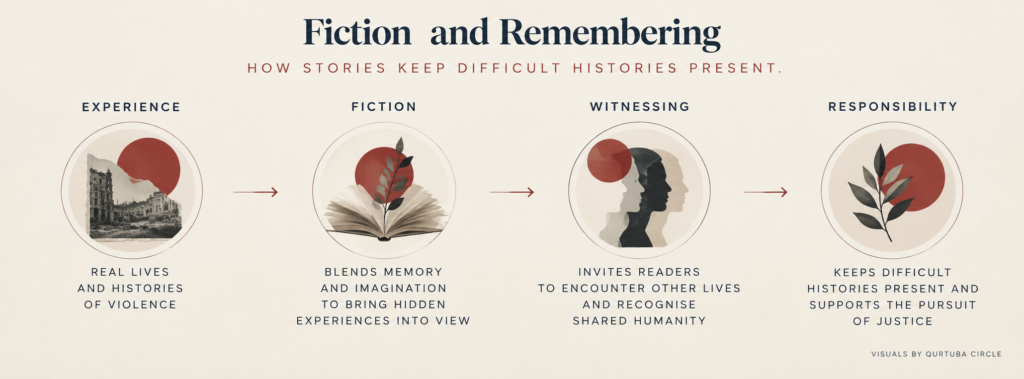
They reveal histories that may lie far beyond a reader’s geographical or cultural location, while making inherited memories accessible through different forms of memory-telling. Fiction asks readers to pause and reflect on the different yet intertwined strands of historical and narrative truths. In doing so, it highlights the disjunct between ‘what happened’ and ‘what it might have felt like’. This distinction becomes crucial precisely because the boundary between the two is rarely clear; it is often fuzzy, obscure and difficult to name. This should not, however, be taken as an argument for replacing historical narratives or official records with fiction. Instead, fiction can function as a complementary resource for understanding lived experiences and marginalized memories that remain invisible within dominant accounts. Fiction performs another crucial function: it creates the possibility of witnessing and positions the reader as a mediated or secondary witness.
By foregrounding a diversity of hitherto unseen, forgotten or silenced experiences, fiction creates space for the reader’s gaze to be drawn to what has been excluded from dominant narratives of the past and facilitates the confrontation of the tensions between what is perceived and what remains hidden.
It is precisely this space that invites the reader to listen to and to encounter the experiences within a work of fiction that extend beyond their own. Witnessing through fiction, therefore, carries an ethical charge. Having encountered these stories, the reader is called upon to acknowledge the existence of difficult pasts and to partake in the collective pursuit of justice and responsible remembering. Such witnessing does not erase or diminish the distance between the reader and the experience represented; rather, it makes that distance ethically significant.
To read, remember and bear witness is therefore to acknowledge what has been forgotten, question what has been rendered invisible and recognise how histories of violence continue to shape the present. Karunatilaka’s insistence that stories must continue to be told thus becomes more than a declaration about storytelling. It becomes an assertion against erasure and a recognition of storytelling as a form of remembrance. To tell, read and remember these stories is to accept the responsibility of listening, acknowledging and refusing their disappearance into silence.
Read More
- I Hope Sri Lanka Learns from Its Stories’: Watch Winner Shehan Karunatilaka’s Booker Prize Speech.” Scroll.in, 18 Oct. 2022
- Kandasamy, Meena. The Gypsy Goddess. Atlantic Books, 2014.
- Keightley, Emily, and Michael Pickering. The Mnemonic Imagination: Remembering as Creative Practice. Palgrave Macmillan, 2012.
- Morrison, Toni. Beloved. Alfred A. Knopf, 1987.
- Spiegelman, Art. Maus: A Survivor’s Tale. Pantheon Books, 1986.

Kavya Mitchi D
Kavya Mitchi D is a doctoral candidate in the Department of Humanities, Arts and Social Sciences at the National Institute of Technology Calicut. Her current research examines the literary representations of the Sri Lankan civil war. Her areas of interest include memory studies, trauma studies and spatiality. She has published and presented papers on the intersections of memory, spectrality and displacement at various national and international conferences. She has received fellowships and conference grants from the University Grants Commission (UGC), Indian Council of Social Science Research (ICSSR), and National Programme on Technology Enhanced Learning (NPTEL).