
At a Glance
From the optimism of postwar consumer culture to contemporary concerns about microplastics and environmental persistence, plastics have become one of the defining materials of modern industrial society. This article traces the history, chemistry, and cultural legacy of synthetic polymers, examining how a material once celebrated for its durability and convenience became associated with some of the most complex environmental challenges of the twenty-first century. By exploring the scientific, historical, and social dimensions of plastics, it argues that the plastic age reveals not merely a problem of waste, but a deeper challenge in how modern societies understand consumption, responsibility, and technological progress.
Key Words: Plastics · Environmental History · Chemistry · Sustainability
This is an autogenerated brief. Please read the entire article for context.
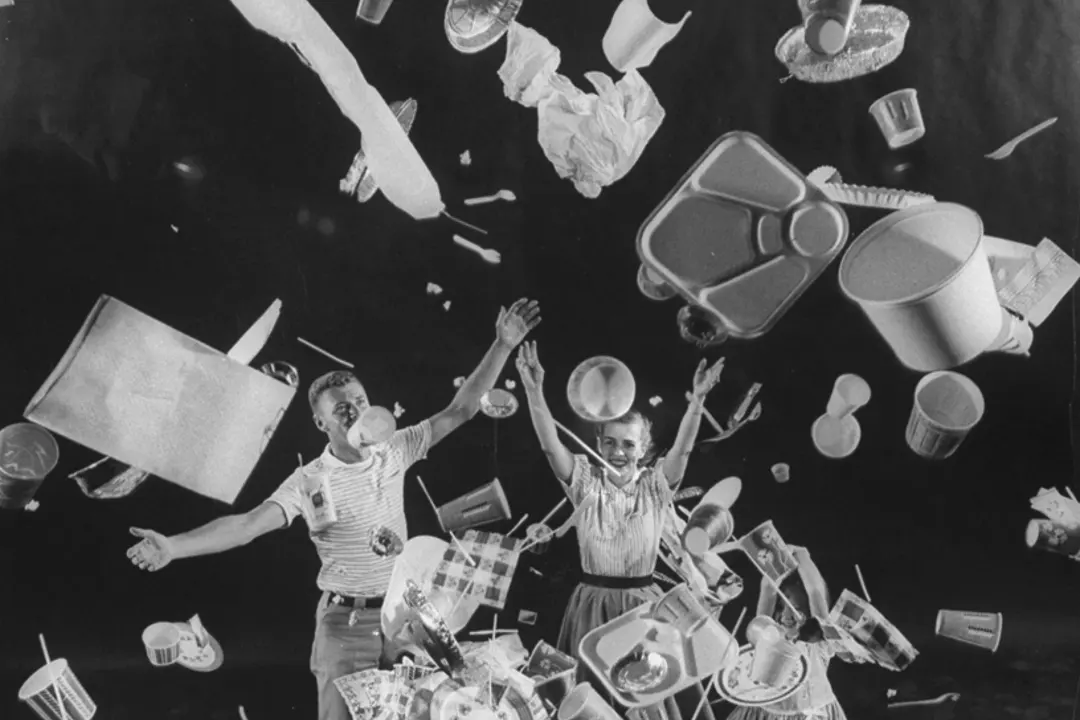
In 1955, Life magazine published a photograph under the headline “Throwaway Living.” A smiling American family stands beneath a rain of disposable objects tossed upward into the air: plastic cups, trays, plates, wrapping, cutlery. All these disposable goods were presented as evidence that industrial society had entered a new material age, one no longer constrained by the limits of fragility, scarcity or repair. The image was meant to celebrate this new age. But in hindsight, the fact that modern societies became capable of engineering materials whose consequences exceeded the scale at which those societies were culturally, economically and psychologically organised to think.
The photograph sure does appear differently now. It is easy to look back at mid-century plastic optimism with condescension, as though earlier generations simply failed to foresee the environmental consequences surrounding them. To understand why that image mattered, it helps to recover the world that produced it. The people celebrating plastics in the 1950s were not irrational. Many chemists, manufacturers and consumers genuinely believed synthetic materials represented one of the great achievements of modern industrial science. In important ways, they were correct.
A Material Revolution
By the middle of the 20th century, synthetic plastics had begun transforming everyday life. It transformed manufacturing, medicine, transport along with domestic life at extraordinary speed. Materials such as Bakelite, nylon, PVC and polyethylene were no longer confined to laboratories or industrial production lines. They appeared in toys, radios, packaging, insulation, kitchenware, clothing and medical equipment. Objects that had once depended on wood, glass, ivory, shellac or metal need not be so anymore.
Plastics got associated with modernity itself.
Was it just novelty that made plastics so popular? Modern tech gadgets can sell on mere novelty but plastics at the time solved real industrial and domestic problems. That is why, they were able to enter homes, schools, hospitals, supermarkets, transport systems and factories. Plastic containers were lighter than glass. Synthetic fabrics were cheaper than silk. Disposable medical equipment improved sterility and reduced contamination risks. Food packaging extended shelf life and simplified transport across growing supermarket economies. For many households emerging from wartime rationing and industrial scarcity, plastics became associated with convenience, cleanliness and modernity itself.
Maybe a chemistry teacher, like myself, explaining polymers during this period would likely have taught them as one of the great achievements of industrial science; a success story in molecular engineering. And chemically, the achievement was genuine.
The Chemistry of Durable Plastic
It was their chemistry that made it all possible. Bakelite, developed by the Belgian chemist Leo Baekeland in 1907, became widely known as the first fully synthetic plastic derived from fossil fuels rather than partially natural materials. It was heat resistant, electrically nonconductive and easy to mass produce. Nylon, developed later by Wallace Carothers and his team at DuPont, replaced expensive natural fibres in products ranging from toothbrushes to parachutes. During the Second World War, synthetic polymers became strategically important industrial materials.
Most common plastics are built from long chains of carbon atoms linked through strong covalent bonds. Polyethylene, one of the most widely used plastics in the world, derives many of its properties from the stability of these molecular chains. Water does not easily break them apart. Many microorganisms lack enzymes capable of dismantling them efficiently. In industrial chemistry, these properties were celebrated because they produced materials that lasted. Durability meant reliability and usefulness. The resistance of plastics to biological degradation was understood primarily as technical success. After the war, those same production systems increasingly turned toward consumer markets.
The Persistence of Plastic
For decades, this resistance to degradation appeared almost entirely as a benefit. What makes the Life magazine photograph unsettling today is not that the people within it misunderstood chemistry. In many ways, the chemistry worked exactly as intended. The disposable objects raining through the air represented the success of a scientific and industrial worldview that treated permanence, flexibility and resistance as material achievements.
The historical atmosphere surrounding those properties, however, did not remain fixed. By the late 1960s and 1970s, environmental researchers and activists had begun drawing attention to forms of industrial waste that earlier decades had treated as secondary concerns. Rachel Carson’s Silent Spring (1962) helped reshape public discussions around synthetic chemicals and ecological systems. Landfills expanded rapidly alongside consumer economies increasingly organised around packaging and disposability. Plastics production continued accelerating globally, eventually surpassing most traditional industrial materials in scale. By the late 1970s, plastics production in the United States had surpassed steel production by volume. The material had become so ordinary, so integrated into modern life, that it often disappeared from conscious attention altogether.
At the same time, marine researchers studying marine pollution and waste accumulation began noticing something difficult to ignore: plastics did not disappear in the ways ordinary disposal language implied. Some remained intact for decades. Others fragmented gradually into smaller particles through sunlight or other environmental exposure. The material changed form, but did not disappear.
Materials engineered for durability were entering systems organised around disposability.
This altered the meaning of polymer stability itself. A chemistry teacher explaining carbon-chain durability today is teaching the same molecular principles taught generations earlier. The chemistry itself has not changed dramatically. What has changed is the world surrounding that lesson. Students encountering polymers now do so in a historical moment shaped by oceanic plastic accumulation, recycling failures, petrochemical expansion and reports of microplastics entering waterways, food systems and even human tissue.
The lesson therefore carries a slightly different weight than it once did because industrial societies gradually discovered that materials engineered for durability were entering systems organised around disposability. The contradiction took time to become visible. A plastic bag used briefly could remain materially present for decades. Synthetic fibres shed from clothing entered waterways invisibly during ordinary washing. Packaging designed for convenience often outlived the social habits that produced it. This is partly why plastics produce a strange kind of historical unease. Many technologies reveal their dangers through visible malfunction. Plastics succeeded too well. Their molecular stability allowed them to become woven into nearly every layer of industrial life before large-scale environmental persistence was allowed to be fully perceptible.
Even recycling, presented widely during the late 20th century as a solution to plastic waste, turned out to be far more limited than public campaigns initially suggested. Industrial recycling systems struggled with contamination, mixed polymer types, economic inefficiency and global waste redistribution. Much plastic waste was never recycled in meaningful quantities at all. Some entered landfills. Some entered marine systems. Some was exported to countries with weaker waste-processing infrastructure. The reassuring circular image attached to recycling often concealed far messier industrial realities.
Beyond Waste: Plastics and Modern Dependence
Even now, the situation resists simple moral conclusions. Modern healthcare systems remain deeply dependent on plastic-based technologies. Sterile syringes, blood bags, IV tubing, surgical gloves and pharmaceutical packaging all rely heavily on synthetic polymers. The plastics scholar Jody Roberts has written about how his own understanding of plastics shifted while confronting the medical technologies necessary for his daughter’s survival. Food preservation systems that reduce spoilage and enable long-distance distribution depend on plastic packaging. The same materials associated with environmental accumulation remain structurally embedded within systems modern societies still consider essential. That is why, the material cannot be reduced easily to either industrial triumph or ecological catastrophe because it remains structurally entangled with both.
Plastic may now just be the monument our civilization leaves behind.
This complexity is one reason researchers increasingly approach plastics not simply as consumer waste, but as part of a much larger industrial and ecological history. Other researchers have focused less on degradation alone and more on the industrial systems surrounding plastic production itself. Environmental historians and sociologists increasingly argue that plastics cannot be understood simply as isolated consumer objects. They belong to much larger networks involving postwar culture, manufacturing systems, petrochemical extraction, global shipping systems, industrial zoning, labour practices and environmental inequality. The petrochemical corridor between Baton Rouge and New Orleans, for example, contains some of the most concentrated petrochemical infrastructure in the United States while also remaining associated with long-term environmental health concerns affecting nearby communities.
Plastic is not merely a consumer object. It is part of an entire historical arrangement of production, convenience and industrial modernity. Economic systems are built around disposability, rapid consumption and endless material expansion. Some scientists investigate enzymatic degradation pathways capable of breaking down certain plastics more efficiently. In 2016, Japanese researchers identified Ideonella sakaiensis, a bacterium producing an enzyme now known as PETase, capable of degrading PET plastics under specific laboratory conditions. The discovery attracted attention partly because it suggested biological systems may slowly be adapting to synthetic materials introduced only recently into evolutionary history.
Geologists have even begun discussing whether synthetic polymers may eventually become identifiable markers within the Earth’s stratigraphic record. Researchers studying “plastiglomerates” — rock-like formations composed partly of melted plastic fused with sediment and volcanic material — argue that industrial civilisation may leave behind synthetic traces embedded directly into future geological layers. Plastic may now just be the monument our civilization leaves behind.
The Psychology of Disposability
Plastics have altered more than just the environment. What plastics altered was not only the material world, but the relationship between consumption and consequence. Earlier materials often remained connected visibly to processes of decay. Wood rotted. Metal rusted. Food scraps decomposed. Even waste retained some perceptible continuity with the environments into which it entered. Plastics disrupted this sensory feedback. Objects disappeared from daily attention long before they disappeared materially.
In the 20th century, industries increasingly reorganised everyday life around convenience, rapid consumption and replacement.
This helped produce a peculiar psychological condition within industrial societies: consequences increasingly became delayed, fragmented and difficult to perceive directly. The supermarket package discarded in seconds continued existing chemically across timescales ordinary consumption was never organised to register emotionally. Plastic therefore did more than accumulate within oceans and landfills. The larger historical shift has happened in human perception.
The historian Susan Strasser, in Waste and Want (1999), argues that disposable culture did not emerge naturally from new materials alone. During the 20th century, industries increasingly reorganised everyday life around convenience, rapid consumption and replacement rather than repair or long-term use. Plastics fit this economic model perfectly. They were cheap to produce, lightweight, easily packaged and simple to discard.
At the same time, older habits of maintenance and reuse were gradually weakened. Products designed for repeated use increasingly gave way to products designed for short-term convenience. Advertising presented disposability as modern, hygienic and efficient. The 1955 Life magazine photograph celebrating “Throwaway Living” captured this historical shift clearly: throwing objects away was no longer treated as wastefulness, but as evidence of progress itself. This is what gives the 1955 Life magazine photograph its strange quality now. The people standing beneath those falling plastic objects were celebrating a real scientific and industrial achievement. People believed they were witnessing the arrival of a more efficient and liberated material future. What remained outside perception was the timescale on which those materials would continue existing after the moment of convenience had passed.
Rethinking the Future of Materials
The tension inside the classroom today is not simply between “good” and “bad” materials. It is harder than that. Plastics reveal how scientific success can acquire entirely different meanings once it enters economic systems organised around disposability, endless consumption and short-term convenience. The questions facing the next generation of chemists may therefore be very different from those that shaped the age of Bakelite and nylon. The challenge is no longer simply how to make materials stronger, lighter or more durable. It is how to imagine materials, industries and economies together.
Researchers have proposed a growing range of responses to the plastic problem: biodegradable polymers, enzyme-assisted degradation, chemical recycling, AI-assisted waste sorting, circular economies and producer responsibility laws. Yet each solution seems to generate new questions of its own. If materials can be designed to degrade, should durability remain the highest goal of materials science? If plastics can be recycled indefinitely, can economies built on continual production & consumption ever become truly sustainable? If producers are responsible for a product’s afterlife, where does responsibility begin and end? And if chemistry is now being asked to solve problems created by earlier chemical successes, how should innovation itself be judged?
Lastly, when historians look back on the plastic age a century from now, will they see a civilisation that learned from its most successful material, or one that remained trapped by it?

Sara Taher
Sara Taher is a chemistry professional and educator based in Egypt. Holding a degree in Science with a specialization in Chemistry, she is passionate about chemical sustainability and environmental awareness, using her scientific background to simplify complex topics and discuss the impact of materials on our world.


A brilliant and thought-provoking article! The way you beautifully bridged the gap between complex chemistry and engaging cultural prose is remarkable. This perspective on sustainable materials is highly needed today.
A piece that hits the nail on the head. We often reduce the plastic issue to mere ‘recycling,’ but you have successfully elevated the conversation to a deeper level: that of rethinking our ‘relationship with time.’ You have provided a masterful historical and scientific lesson on how a ‘technical triumph’ has transformed into an ‘ethical dilemma.’ This article is not just a piece of prose; it is a call to re-evaluate our entire perception of modernity and progress. It is a piece that deserves to be part of any curriculum, as it has the power to reshape the consciousness of future generations regarding their consumption habits.